Central Nervous System:
The CNS is the site of processing of information and control.
The structure of CNS is derived from the embryological component.
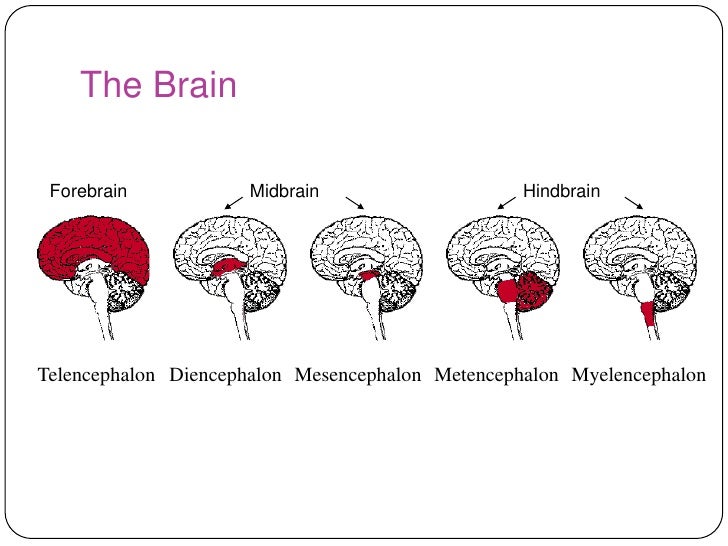
Prosencephalon
· Becomes the thalamus, hypothalamus, and cerebral cortex.
Mesencephalon
· Becomes the mid brain.
Rhombencephalon
· Becomes the pons, medulla, and cerebellum.
Human Brain:
The human brain is well protected by the skull. The skull is composed of two sets of bones-cranium and facial. The brain is covered by three layer called cranial meninges.
· Durometer: The outer layer of the cranial meninges. Its tough and thick, made up of fibrous tissue.
· Arachnoid: The middle layer made up of delicate connective tissue.
· Pia mater: The inner layer which is in contact with brain tissue.
Subdural space: It is the space b/w dura mater and arachnoid.
Subarachnoid space: It is the space b/w arachnoid and piamater. This space contains cerebrospinal fluid.
Divison of the human brain:
· Forebrain: It forms the major part of the brain. It is composed 0f thalamus, hypothalamus, and cerebrum.
· Cerebrum: Cerebrum is a spherical structure which is made up of left and right cerebral hemisphere. Each hemisphere is further made up of 4 lobes- frontal, parietal, temporal and occipital.
i. Frontal lobe: It is where the creative ideas originate and translation of perception into plans of muscle movement.
ii. Parietal lobe: It is where the feeling of cold, hot and touch registered.
iii.Temporal lobe: It is where the sounds are interpreted,
iv. Occipital lobe: It is where the sensation of light and visual information are decoded.

The two hemisphere are connected by the bundle of fiber called tracts.
The tracts of fiber are also called corpus callosum. The anterior part is curved called genu and posterior part is called splenium.
The outer surface of the cerebrum is called gray matter due to the concentration of the cell bodies while the inner surface is white matter due to the presence of myelinated sheath.
Both the cerebral hemisphere are highly conflated. This convulsion consists of sulci (small groove), fissure(large groove) and gyri(bulge b/w sulci and fissure). Their presence increases the surface area of the cerebrum.
Destruction of dopamine secreting basal nucleus called substantial nigera leads to Parkinson's disease. Huntington's chorea is caused due to degeneration of GABA-secreting neuron andAcetlycholnie secreting neuron.
The cerebral cortex is divided into three major parts:
i. Motor area controls the movement of the skeletal element.
ii. Sensory area: receives various types of sensation.
iii. Association area:
a. Intersensory association: association of movement of skeletal element and various sensation.
b. Memory: memory of the past is recorded by association area.
c. Communication: ability of communication are controlled by association area.
· Thalamus: The cerebrum wraps around a structure called thalamus. It’s the relay center of cerebral cortex. It controls the motor and sensory signaling.
· Hypothalamus: It nestles at the base of the thalamus.
i. It controls the body temperature by means of a thermostat system. It keeps the water content of the body constant by regulating amount of urine and thirst. It controls hunger by arousing hunger pangs making the person aware of his need.
ii. It also controls the endocrine function of the body. The hypothalamus contains neurosecretory cells which secrete hormones. these neurosecretory cells are in fact hypothalamic neurons. Gonadotropin-releasing hormones, anti-diuretic hormone, and oxytocin are few examples.
Limbic system: The amygdala, hippocampus forms the limbic system. Hypothalamus along with limbic system regulates the aspect the human behavior. Amygdala controls the moods while the hippocampus deals with the signals about smell and memories. The hippocampus converts the short term memory into long term memory.

· Mid brain: it is the present b/w the thalamus and pons of hind brain. The mid brain consists of 4 lobes which collectively are called corpora quadrigeminal. the two upper lobes are called superior colliculi and two lower lobes are called inferior colliculi.
The superior colliculi control the visual reflexes and control the movement of eye and head . the inferior colliculi controls the auditory reflexes and the movement of head to locate the sounds signal.
· Hind brain: It comprises of pons, medulla, and cerebellum.
· Pons: Consists of fiber tracts that interconnect the cerebral cortex and the cerebellum. A center present in the pons called pneumotoxic center can moderate the respiratory rhythm.
· Medulla: Medulla oblongata connects the various parts of the brain to the spinal chord. The medulla contains center which controls respiration, cardiovascular reflexes, and gastric secretion.
· Cerebellum: Three paired bundles of myelinated nerve fiber form the cerebellar peduncles which serve the function of communication b/w cerebellum and other parts of CNS. The superior peduncles connect to mid brian, middle peduncles communicates with the pons and the inferior peduncles to medulla oblongata.
Mid brain and hind brain form the brain stem.
Ventricles of the brain:

The ventricles are four hollow fluid-filled spaces in the brain. Each cerebral hemisphere has lateral ventricles. Lateral ventricles are connected to the third ventricle by interventricular Foramen. The third ventricles in the mid brian are connected to the fourth ventricles in the pons by cerebral aqueduct or aqueduct of Sylvius. Three opening in the roofs of the fourth ventricle, a pair of lateral aperture and median aperture allow the CSF to move upward to the sub arachnoid space. The CSF ids secreted by choroid plexus and it acts as the shock absorber for the brain and spinal chord and nourishes the brain tissue.


Comments
Post a Comment